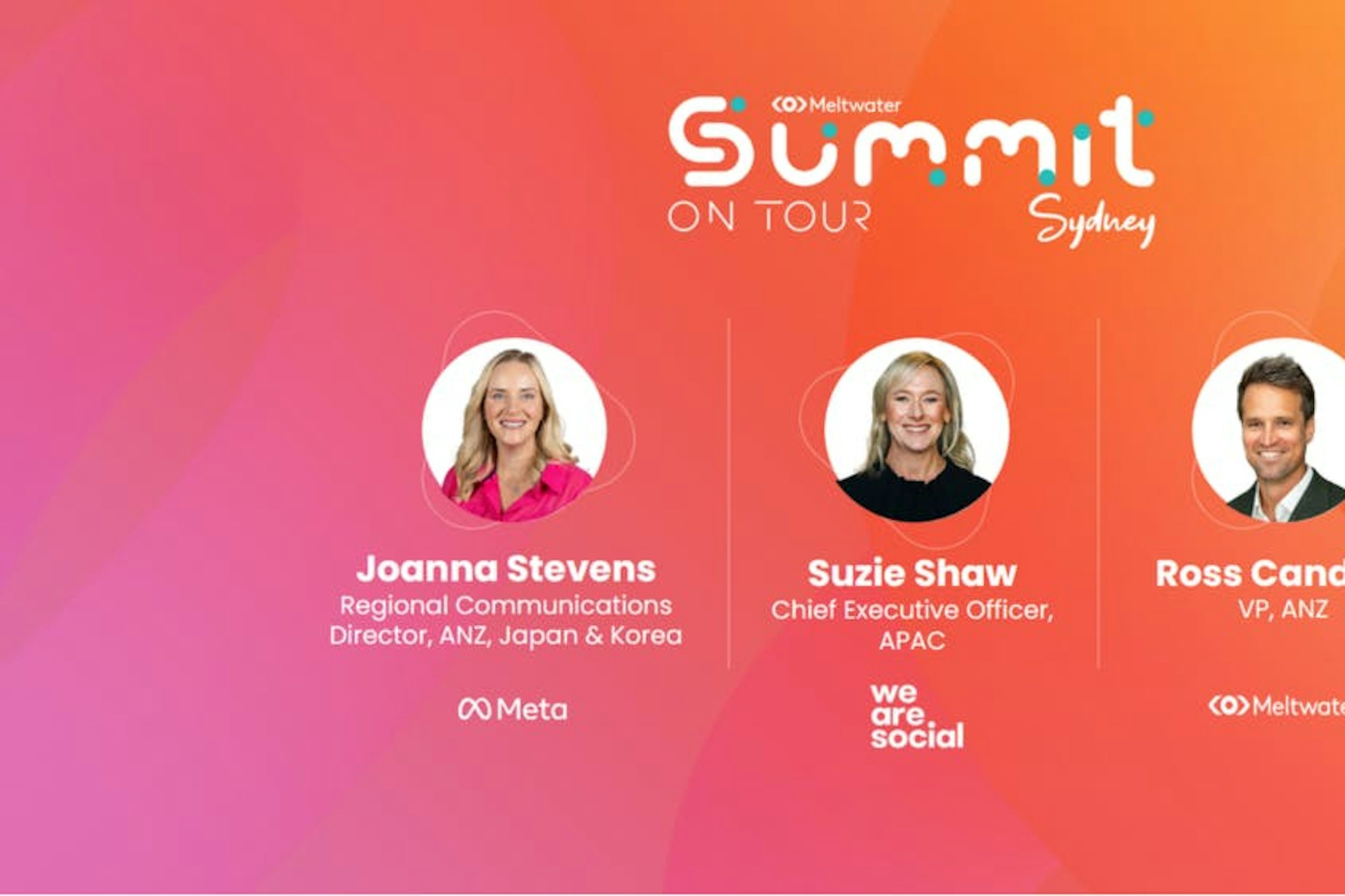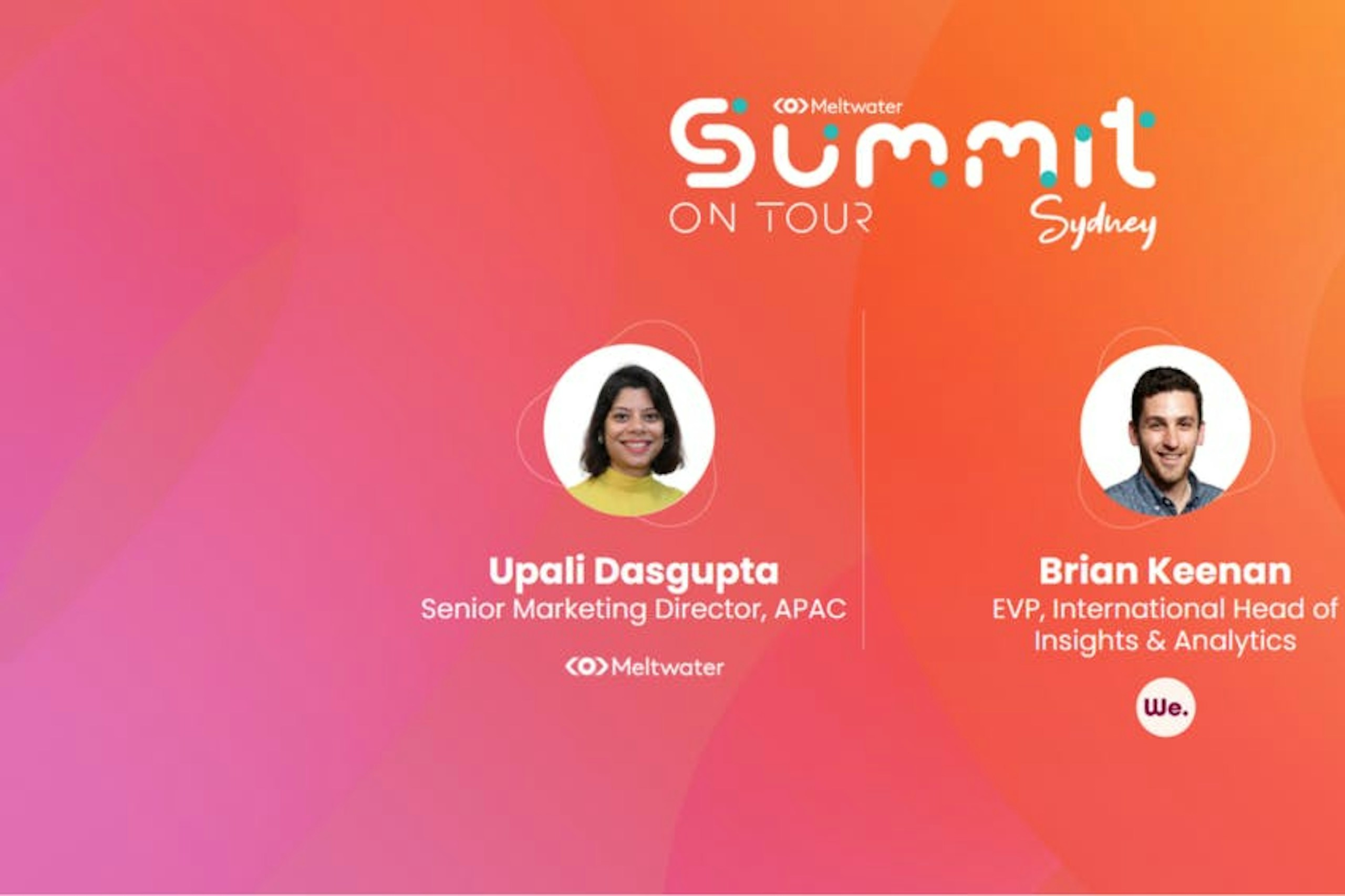

Sydney's Redfern precinct played host to Meltwater’s first Summit on Tour: Sydney, bringing together communications, PR, and marketing leaders from across Australia to discuss a common challenge: how do organisations navigate a world where brands are being shaped by more voices, across more channels, and at greater speed than ever before?
From traditional media and social platforms to online communities and AI-powered answer engines, the conversations throughout the afternoon pointed to a communications landscape that is becoming increasingly complex. Yet despite the pace of change, one theme emerged consistently: success depends on understanding the narratives shaping organisations and knowing when and how to respond. Here are five key takeaways from the day.
Contents
Marketing and Communications Teams Are Entering the Intelligence Age
Brands are Being Shaped Across a Multi-Voice Landscape
Trust Must Be Built Before It's Needed
Reputation Intelligence Is Becoming More Predictive
AI Visibility Is the Next Brand Visibility Challenge
What This Means for Marketing and Communications Leaders
Marketing and Communications Teams Are Entering the Intelligence Age
Opening the event, Meltwater Chief Product Officer Chris Hackney highlighted how marketing and communications teams are entering a fundamentally different operating environment.
We're all entering a new age of narrative intelligence — a new age where organisations discover signals, understand the narratives within them and take action at the speed of those narratives and the media environment as it exists today.
For years, communications professionals focused on monitoring media coverage, tracking conversations, and measuring campaign performance. Today, Hackney noted, monitoring alone is no longer enough.
Reputation is increasingly shaped across a network of news outlets, social platforms, online communities, creators, and AI-powered answer engines. Understanding what is being said remains important, but organisations must also understand how narratives form, evolve, and spread across channels.
Hackney pointed to a new generation of intelligence tools designed to help teams move beyond reactive monitoring and towards earlier signal detection, trend identification, and faster decision-making. The message was clear: the challenge is no longer simply keeping up with conversations, but identifying which signals matter before they become reputation outcomes.
Brands are Being Shaped Across a Multi-Voice Landscape
That theme carried through discussions on Australia's changing media environment.
A panel featuring Oren Fixler (Telstra), Rory O'Connor (Commonwealth Bank), David Eisman (Capital Brief), and Ashleigh Thomas (Nine) explored how dramatically audience behaviour and information consumption have changed.
The panel discussed how, while Australia's media market remains relatively concentrated compared to many global markets, audience attention is becoming increasingly fragmented, particularly among younger Australians who consume news and information across social platforms, creators, online communities, and traditional publishers.
One standout discussion point is that the traditional idea of a channel mix no longer reflects reality.
I don't even think about it as [a] channel mix anymore. It's like layers of influence. We still have to be in most of these places, but we have to think really deeply about who we're trying to influence and how effectively we can use that channel to do that.
Stories now move fluidly between news outlets, social platforms, online communities, creators, and AI-generated answers. A discussion that begins in a niche online forum can quickly become a mainstream media story, influencing audiences across multiple channels simultaneously.
That dynamic has also increased the challenge posed by mis- and disinformation. O'Connor shared an example of a fabricated video appearing to show a Commonwealth Bank executive walking out of a television interview. While entirely fake, the content was convincing enough to gain attention online, highlighting how quickly misinformation can spread and how difficult it can be to contain.
The ability to identify this sort of content quickly and then address it needs to be a key part of our arsenal – and is something that companies like Meltwater are helping us do.
Later sessions featuring Suzie Shaw (We Are Social) and Joanna Stevens (Meta) reinforced the idea that audiences increasingly experience media, social content, creator influence, and corporate communications as part of a single narrative.
Brands are built or broken online now. That's where reputation is.
The result is a communications environment that is simultaneously fragmenting and converging, with more channels, more voices, but increasingly interconnected narratives.
Trust Must Be Built Before It's Needed
If the earlier sessions focused on how narratives spread, the next discussions explored how organisations build enough trust to withstand them.
Melissa O'Neill, Chief Corporate Affairs Officer at Bunnings, shared how one of Australia's most trusted brands approaches reputation and community engagement. Rather than treating trust as a communications initiative, O'Neill described it as something built through long-term consistency, community investment, and stakeholder relationships.
The University of Sydney offered a different perspective on trust during periods of sustained disruption. Reflecting on a year that included student protests, cybersecurity incidents, policy debates, and intense public scrutiny, Clare Masters and Johanna Lowe discussed the importance of authenticity during moments of pressure.
People will remember tone as much as they will remember what was said so a focus on really authentic human statements is really important for any institution.
Lowe also shared how the university identified and addressed a student results issue after conversations began emerging on Reddit, demonstrating the growing importance of early detection and rapid response.
For the university, data has become an important tool for distinguishing genuine reputation risks from short-term noise.
Don't bring a hunch to a data fight. Bring out the data — it's your superpower in the room.
Both sessions highlighted how trust is earned long before organisations need to rely on it.
Tip: Learn more about Trust in the Age of AI and understand what consumers really think about AI-generated content.
Reputation Management Is Becoming More Predictive
As trust becomes increasingly valuable, communications leaders are also looking for better ways to understand and measure it.
Meltwater Executive Director David Hickey challenged the idea that reputation scores alone provide enough insight for modern communications teams.
Reputation is formed before it is measured.
While reputation benchmarks remain valuable, Hickey highlighted that they often capture outcomes after perceptions have already been shaped in real-time communications channels.
To illustrate the point, he highlighted Bunnings' ability to maintain strong reputation scores despite navigating several high-profile reputation challenges. The example demonstrated that reputation metrics can reflect the result without revealing the work required to achieve it.
This discussion formed the basis for Meltwater's newly announced APAC partnership with RepTrak, which aims to explore how media intelligence and reputation measurement can work together to identify stronger connections between narratives, channels, and reputation outcomes.
It will help [organisations] stop chasing their tail so much. Stop feeling that they need to respond to every single thing that's out there.
The goal is not to replace reputation measurement, but to make reputation intelligence more predictive and actionable.
AI Visibility Is the Next Brand Visibility Challenge
One of the most popular sessions focused on one of the fastest-moving developments in communications: AI-powered discovery.
We. Communications' International Head of Insights and Analytics, Brian Keenan talked about how AI answer engines such as ChatGPT, Gemini, Claude, and Perplexity are becoming a new layer of influence.
Earned media was the OG, next came social and influencers, and now you have generative engines.
As more people use AI-powered search and answer engines to discover information, evaluate products, and make decisions, organisations face the new challenge of understanding how they are represented within AI-generated answers.
Keenan argued that organisations today increasingly need to "double code" for influence — creating content not only for human audiences, but also for the AI systems that discover, interpret, and surface information.
Importantly, he highlighted that AI visibility is not solely a marketing challenge. AI systems frequently draw on owned websites, earned media, executive thought leadership, expert commentary, FAQs, and corporate messaging, areas traditionally owned by marketing, communications, and other teams across the organisation. Improving visibility in AI-generated answers will require a coordinated effort across functions.
For organisations still early in the journey, his advice was straightforward: start by auditing how your brand currently appears across AI platforms before attempting to optimise for them.
What This Means for Marketing and Communications Leaders
The conversations throughout Summit on Tour: Sydney pointed to an Australian communications landscape that is becoming more complex, but also more interconnected.
Media, social platforms, creators, communities, and AI-powered answer engines increasingly influence one another, creating a multi-voice environment where reputation is shaped continuously and often simultaneously.
For communications leaders, success will depend on more than monitoring channels. It will require understanding how narratives move between them, identifying meaningful signals before they become outcomes, and building trust long before it is needed.
The intelligence age is no longer approaching. It has arrived, and the organisations best positioned to succeed will be those that can turn insight into action faster than the narratives around them evolve.
FAQs About Meltwater Summit on Tour: Sydney 2026
What was Meltwater Summit on Tour: Sydney 2026?
Meltwater Summit on Tour: Sydney 2026 was a half-day event held in Redfern that brought together communications, PR, marketing, and corporate affairs leaders to discuss reputation management, media trends, trust, and the growing impact of AI on brand visibility.
What were the main themes discussed at the event?
The event focused on five key themes: narrative intelligence, Australia's evolving media landscape, trust and reputation management, predictive reputation intelligence, and the rise of AI-powered answer engines such as ChatGPT, Gemini, and Perplexity.
What was announced at Meltwater Summit on Tour: Sydney 2026?
Meltwater announced a new APAC partnership with RepTrak to explore the relationship between media intelligence and reputation measurement. Speakers also discussed new capabilities designed to help organisations identify emerging narratives, monitor AI visibility, and improve decision-making through real-time intelligence.
Who spoke at Meltwater Summit on Tour: Sydney 2026?
Speakers included Chris Hackney (Meltwater), David Hickey (Meltwater), Melissa O'Neill (Bunnings), Joanna Lowe and Clare Masters (University of Sydney), Brian Keenan (We. Communications), Upali Dasgupta (Meltwater), Oren Fixler (Telstra), Rory O'Connor (Commonwealth Bank), David Eisman (Capital Brief), Ashleigh Thomas (Nine), Suzie Shaw (We Are Social), Joanna Stevens (Meta), and Kate Hamilton (RepTrak).
What is narrative intelligence?
Narrative intelligence refers to the ability to identify emerging signals, understand the narratives forming around a brand or issue, and take action before those narratives become reputation outcomes. It was a central theme of Chris Hackney's opening keynote.
Why is reputation becoming more difficult to manage?
Speakers highlighted that reputation is no longer shaped through a single channel. News media, social platforms, creators, online communities, and AI-powered answer engines all contribute to how organisations are perceived, creating a more complex and interconnected communications environment.
What role does AI play in brand visibility?
AI-powered answer engines are increasingly influencing how people discover information, evaluate brands, and make decisions. As a result, communications and marketing teams need to understand how their organisations are represented in AI-generated answers and what sources influence those responses.